Showing posts with label Split. Show all posts

Thursday, July 16, 2015

2015-07-15: Cut Out Hive and New Queens!

I've finally accomplished two of the goals I set for this year: split my hives and get some better genetics with some Michigan raised "survivor" queens!  I learned about the Northern Bee Network at the Michigan Beekeepers conference in the Spring, so I went through their list of Queen breeders and found one that followed practices I conform to.  I placed an order for three queens and on Wednesday morning I received a phone call at 6 AM from the post office telling me to come get my bees.

Three Queens
The Splits:

The basic concept of how I was going to do my splits was to select two frames of open/capped brood and two frames of honey/pollen from the donor hive and place them into the 5 frame nuc box.  The remaining frame would be an empty frame with plastic foundation with the new queen cage on it.  Key number one is making sure you don't accidentally transfer your existing queen into the new hive!

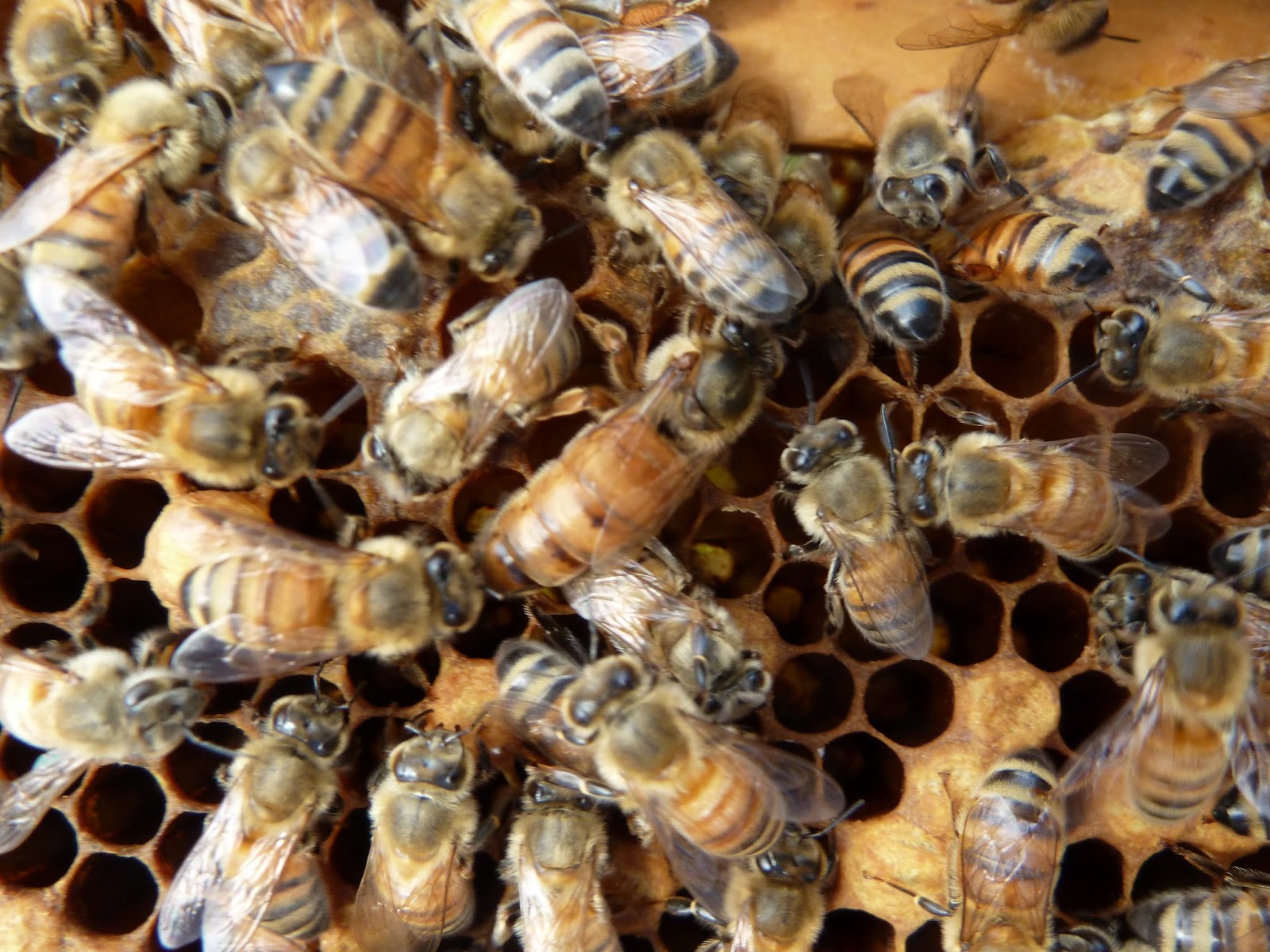
I began in Green Hive by quickly scanning a few frames in the honey supers just to see how they were doing.  Almost every frame of foundation was drawn and filled with nectar.  They are doing great!  I then removed the two honey supers and started going through the brood boxes.  The first few frames on the outside were solid honey.  After I made a few adjustments to the bulges in the comb, I transferred them to the nuc box.  Two honey frames done.  Now to find the brood frames and the queen.  Next few frames had some eggs and a lot of honey so I didn't take them.  Frame five had some nice capped brood, so I meticulously studied it looking for the queen.  Flipped the frame over and looked for her again.  Back and forth two more times after that and I was satisfied she wasn't there.  I walked over to put it into the nuc and checked it one more time.  In it went.  Frame number six was another good brood frame.  Looking....looking....flip....looking....bam!  There she is hiding in the gap between the frame and the comb.  Each time I flipped the frame she'd run back to the other side.  Sneaky!  I took a queen marking cup my wife had bought for me and scooped her up into it and set her off to the side (more on this later).

Queen in the marking cup
I took this frame and into the nuc it went.  I pulled out the first queen cage and the queen looked alive and well inside.  I then noticed it had a piece duct tape over the end.

Queen cage
I assumed the duct tape was to prevent the candy from being eaten by the bees during shipment, but since the end is stuck down into a hole in the shipping cage, I'm not really sure how they would get to it.  Anyway, I removed the tape, exposed the candy and wedged the cage in between two of the frames.  First nuc complete!  I took another one of the queen cages and put her into the donor hive and closed it up.

First nuc complete
The second nuc was a bit more difficult.  After pulling off the honey super I went through the entire first brood box and only found one good frame of honey and one good frame of brood.  I did spot the queen and made sure that frame was out of the way.  I had to go into the bottom box to look for two more frames.  Generally I don't really go into the bottom box unless I really have to.  You always end up crushing some bees when moving boxes around and they are also really heavy!  Thankfully I pulled the first frame in the bottom box and it was solid honey.  Into the nuc with you!  The next frame was a fantastic brood frame!  Nuc #2 was complete with the added plastic frame and queen cage.  I replaced the frames from the donor hive with the same empty plastic frames and put the boxes back together.

This all sounds pretty simple but all told it took about 3.5 hours!

Requeening:

Remember that queen I had removed and put into the marking cup?  Well, the reason I removed her from the hive was because I was noticing many signs from this hive of what I think is Chronic Bee Paralysis Virus. The characteristic symptoms are bees with a greasy black shiny appearance, trembling bees unable to fly, clusters of bees walking on the ground and healthy bees trying to drag the sick bees out of the hive.  I was able to spot all of these symptoms.

Sick "greasy" looking bee
Clusters of bees walking on the ground
Sick bees being dragged out
This disease is typically vectored in from the dreaded Varroa mite.  I haven't done mite counts yet this year but when I do I wouldn't be surprised to see a higher count in this hive.  Since they don't have treatments for this disease, the recommendation is to requeen the hive.  This will give some new genetics that hopefully won't be as susceptible to the disease, as well as giving a break in the brood cycle while the new queen is being released and eventually begins to lay eggs.  The break in the bee's brood cycle also gives a break to the Varroa mite's cycle as well since they only reproduce in capped brood.

So as far as requeening goes, putting a new queen into the hive is one thing.  Removing the old queen is another.  And dispatching the old queen yet another.  Is it sad that I was getting all worked up over having to kill the old queen?  Well, I couldn't get myself to just "pinch" her.  Since you can make a swarm lure by soaking dead queens in alcohol, I though about just tossing her into a jar of alcohol.  But the thought of drowning freaks me out so I couldn't do that either.  I finally decided to put her in the refrigerator.  If it is anything like dying from hypothermia, then slowly "going to sleep" from the cold might not be such a bad way to go.  I hope it works that way anyway!  Green Hive queen is dead.  Long live the new queen!

Cut Out Hive:

 The bees from the cut out seem to be settling into their new home, Yellow Hive.  I have fed them two mason jars filled with honey so far to make up for all the honey I stole from them during the cut out.  I found the girls have done a really good job of attaching the combs rubber banded into the frames.  And they've started to chew through the rubber bands as well.

Cut out comb
 There are plenty of larva on the frames as well as nectar and pollen so that is a good sign.  The not so great sign is that I did NOT get the queen.  Here is the evidence:

Emergency Queen cells
I spotted numerous capped and uncapped emergency queen cells across a number of frames.  Probably around 8 in total.  The good thing is that at least they had some viable larva that they could start turning into queens.  I had thought about ordering another queen to place into this hive but since they already have some capped cells, I decided to let them raise their own queen.  A capped queen cell should emerge in about 8 days from now.  Twelve days after that (assuming she has good weather for her mating flights and doesn't get eaten by a bird) she should be laying eggs.  So, sometime in mid August Yellow Hive should be back in action again!


Next Steps:

I'll be checking the hives to make sure the new queens have been released in a few days.  After that I will do another full inspection to make sure there are new eggs and larva.  I'll plan on doing some mite sampling at that time as well.

Until then.......thanks for reading!

Thursday, August 1, 2013

Post Action Assessment: 07-30-2013

Task number one during this inspection was to check the split hive and hopefully find evidence of a laying queen or at least find the (hopefully) non-virgin queen.  Task number two was to check White Hive to see if the queen cells spotted last time were completed or destroyed and if I actually have a laying or virgin queen in that hive as well.

Split Hive:

The population in this hive is still very low.  I had put the extra box of honey on the hive to make sure they had enough but I think I have given them too much space for too few bees.  There are lots of ants roaming around unchallenged eating honey.  They don't bother the bees but in a strong hive they wouldn't be in there at all.  The low population does make it much easier to inspect the hive and spot a queen though!  I quickly went through the box of honey and found a few bees but no queen (nor did I expect to find her there).  Going through the brood box I found some honey and nectar and a tiny bit of pollen but I found no evidence of a queen (virgin or otherwise) and no evidence of eggs, or larvae.  Based on the "bee math" I provided a link to in the last blog post, it could still be a bit early for the hatched queen to have flown out, mated and returned to lay eggs.  I'm really hoping that we did not scare her off during our last inspection and she did not come back!  At this point, I will give it one more week before I take some other action.  It is pretty late in the season, so the only practical option may be to just recombine this hive back into White Hive.

White Hive:

One of my goals this year was to keep better records.  But I am finding that I just don't have enough hands to record things on paper, plus take pictures, all while trying to manipulate frames and smoke, etc.  So this time I tried to just take a photo of each side of every frame.  It was still very clumsy but I made it happen.  Photos are great because you can often spot things that you did not see while inspecting the frames.

Inspecting the top box, it was mostly filled with honey along with a few frames of foundation that the bees have barely touched.  Having a filled frame next to an empty one just makes the bees want to draw out the filled frame even more, so I have some giant frames of honey in there!  I'll pull those for sure this fall.

The bottom box also had a lot of honey and the pollen stores seemed much larger this time.  Possibly this is because there are no larvae to feed the pollen to! 
Honey and Pollen on frame 2

I kept moving through the frames hoping to find the hatched queen or the queen cups I had spotted last time.  I hit frame number four and there was the queen!
Queen Spotting can be challenging!
Can you see her?  It always gives me a jolt when I finally spot her. 

She is in the middle of the frame a few inches down from the top.  Here she is a bit closer:

I spotted the queen, but is she the old queen or the new queen?  And what about those queen cups I saw last time?  To answer these questions I need to see if this queen is laying eggs and if the bees destroyed the queen cups.  Onward!

I continued to find patches of brood that have not hatched yet as well and large open areas with nothing in them.  Some pollen and honey on almost every frame though.  On frame 7 I hit a small patch of drone brood and this is the frame I spotted the queen cups on.

This picture wasn't as good as the one from last time, but you can see they are still open and have not been capped and turned into full queen cells.  It looks to me like the bees removed the two larvae that were in these cups.  I assume they realized they had a queen and no longer needed to raise a new one.  This is a good sign!  My main goals accomplished, I finished inspecting the remaining frames and closed up the hive.  I looked very closely at each frame and I could not find any eggs or larvae for sure.  On the photos for frame 6, if I zoom in very closely, I can see what MIGHT be a few eggs but I'm not sure.  I guess I will know which frame to look on during the next inspection to see if those phantoms have turned into larvae!
Possible eggs in the empty area to the right of the capped brood?
All in all I was pretty happy to "bee" back on track with at least one hive!  We shall see what the next inspection reveals!

On a side note, I planted some Borage this year in my garden because I had read that bees really like it.  I'd never even heard of the plant before, but as you can see in the photo, they like it!

Until next time, thanks for reading!

Monday, July 22, 2013

Mistakes Were Made: 07-21-2013

Sunday was a great day to work the bees for a number of reasons.  First off, my son-in-law Chris and my daughter are visiting from California and he wanted to dive into the hives with me!  Second, the weather was just perfect.  Temps in the 70s, clear and sunny.  If any of you other beekeepers out there are anything like me (and I'm sure you are), then you love teaching others about bees.  This was a great opportunity, even though I didn't expect to be able to show Chris any stages of brood development (see the last two posts).  As you are about to read, this was not the case!!

Since the split and insertion of the two queen cells during my last inspection, my plan was to get in and first check to see if they have hatched.  Hopefully I could spot a virgin queen running around in the process.  I already know that the split hive has significantly less bees in it, as there is very little activity at the hive entrance.  Because of this, I also planned on either moving a frame of bees into the split hive or just shaking them off the frames and into the split hive.  With plan in place, Chris and I suited up, lit the smoker and headed out to the split hive.

Split Hive:

This was going to be a good training and teaching hive because there were not going to be a lot of bees and it would be much easier to point things out.  Plus, not having a bunch of bees flying around your head is a bit less intimidating for someone's first time.  We opened the hive and I was able to go through the honey super pretty quickly.  There were only a few bees there and solid honey frames all look the same after seeing  a few.  I removed that box and started digging through the brood box, eager to get to the frame with the queen cell on it!  After prying back the fourth frame, I could see the bottom of the queen cell was opened so the queen was out somewhere!  We removed the queen cell and started in on the next frame and BAM there was the hatched virgin queen!  I pointed her out to Chris and in the 10 seconds it took to get the camera out to grab of picture of her........she as gone.  I flipped the frame over and back again a few times and she was no longer there.  She must have gotten spooked and flew off.  Camera shy I guess.  We went through the rest of the frames and we found a bunch more honey, but I was concerned that I didn't find any stored pollen.  That might be OK for the moment, but if the virgin queen does fly out and mate, comes back and starts laying eggs, there had better be some pollen in there to feed the baby bees!  We put the honey super back on the hive and put the inner cover back on.  I left the telescoping cover off at this point in case the queen came back she could get back in the hive a bit easier.  On to White Hive.

White Hive:


We opened up this hive and there were a lot more bees here as expected.  After a bit more smoke into the hive (Chris was my head smoker and picture taker) we dove in and quickly went through the honey super and set it to the side.  After a bit of coaxing I was able to get the first frame out and begin the inspection.  With the first few frames inspected, I was really pleased to see some pollen and "bee bread" packed into the cells.
After inspecting the next few frames, we came across a frame that had a bunch of drones and a queen cup on it.

I love spotting drones, especially when I am trying to teach someone about bees.  They are easy to distinguish because their large size and big eyes stand out so much.  Can you spot the drones in this picture?  There is a hole close to the middle of the frame with two drones above it and a queen cup to the right. 

I checked inside the queen cup just to make sure there was nothing in it, and there was nothing in there.  I continued on and began checking the next frame in line.  I slowed down a bit since the closer I was to the frame with the queen cell, the higher the probability that I would be able to spot the emerged virgin queen (if she was there at all).  I pulled the frame with the queen cell and sure enough, she had hatched.  The bottom of the cell was open and hopefully she was running around inside the hive.  I proceeded to move the frame out of the way and pulled the next frame out and I find..........BROOD?!?!?!  What??

At first I thought it must be all drone brood and perhaps I had laying workers but after seeing this on the next two frames and spotting a few actual drone cells, this must be worker brood.  How is this possible?  Well, the answer is that I screwed up.  I must have missed the eggs and larvae in these frames during my last few inspections and/or I simply didn't pull the frames that had the brood on them, so I never spotted it.  So now what?  I would think that if there is a laying queen in this hive, that she would have instantly killed the virgin queen inside the queen cell.  This wasn't the case because the virgin hatched out and was not dead inside the cell.  Perhaps the laying queen didn't spot the queen cell until after the virgin hatched and they eventually found each other and fought to the death?  Which one survived?  By this time I am scrutinizing every inch of each frame trying to find either queen.  I pull the next frame and I spot this....

If you look closely, not only are there two queen cups here, but this time they are full of royal jelly and I can spot a larvae in one of them (no doubt there is a larvae in the other one as well).  What the heck is going on?  If there is an existing laying queen, why were the bees trying to create a new queen?  If there are larvae in these queen cups, then that means they are somewhere between 4 and 8 days old (http://www.bushfarms.com/beesmath.htm) right around the time I placed the queen cell in this hive.  Coincidence?  I think I need to give Sherlock Holmes a call because I can't quite sequence the timing and all the possibilities together to form a rock solid answer to what is going on.  Usually, queen cells built in the center of the frame like this are considered Supercedure cells.  This means the bees have decided that the old queen is beginning to fail and they have determined to replace her.  Maybe that is what was going on and my timing was just really bad?  Who knows?

We finished inspecting the remaining frames and failed to spot either the old queen or the virgin queen.  At this point there wasn't much left to do but close up the hive.  I did take two of the frames out and after closely inspecting them (and not finding any queens), I took them over to the split hive and shook the bees into it.  Hopefully that will give them a few more bees to supplement their numbers until the virgin queen mates and starts laying eggs to make new bees!

Hopefully, I will open the hive in another week and what I find will give more answers to the mystery.  All in all it was a very educational inspection, not only for "newbee" Chris but for me as well!! 

Thanks again for reading

Chris and Mark about to embark on an adventure!


Thursday, July 18, 2013

Swinging for the Cheap Seats: 07-17-2013

I scrambled around the last few days trying to find a queen producer that actually had queens for sale.  I found a few places online that are still producing and selling queens but it seems that shipping them is pretty risky.  Who knows how much they'd get thrown around or squashed in transit or how hot or cold they would get!  Not to mention, shipping isn't cheap.........and I'm cheap.  I talked to a guy I work with and he suggested talking to the same person I bought my initial packaged bees from.  Duh!  So, I called Kline's and they didn't have any queens but they did refer me to someone that might.  I called that guy and he was sold out BUT he did have some queen cells AND he lived right in between where I live and where I work!

For those of you unaware of the differences and risks involved, basically you can buy a mature queen that is mated and actively laying eggs and you can introduce her into your hive via a cage and over the course of a few days the bees in the hive will accept her as their new queen.  Once this happens you can release her from the cage (otherwise the bees would kill her).  With a queen cell, it is an unhatched, virgin queen.  This means you can just put the cell in the hive and she will hatch out in a few days and smell like all the other newly hatched bees.  But she is a virgin and will then have to fly out and mate and then return to the hive.....all without getting eaten by a bird or smacking into a car windshield.

Since I'm kind of in a bind being queenless and I don't want to take the risk of shipping (and extra time waiting for shipment), I decided to go with the queen cells.  To mitigate some of the risk, I bought two.  My thought was that I would split my queenless hive and put one queen cell in each box.  In this way, if only one queen hatches and mates successfully, I could easily re-combine the two hives back into one.  Or, I could even move frames of brood from the new queen hive to the queenless one and eventually have them raise a new queen.  Worst case scenario is that both queen cells do not produce a mated queen.  Best case is that both do.

Temperatures were forecast to be in the mid 90s, so I went early in the morning to pick up the queen cells.  The guy was great and showed me around his entire operation.  He showed me all his hives and had me suit up so he could show me his queen builder colonies and how he did his grafting and queen rearing.  Very cool stuff!  The only bad thing is that is was 11 AM and already 88 degrees by the time I left.  Once I was home, I think it was about 92 degrees and I was not excited to put on my bee suit.  I put out some cinder blocks and a hive bottom board and began to split the hive.  Honey super and top brood box off.  Bottom brood box off and carried over to the new hive bottom board.  Hive tool moves two of the middle frames apart, hold the queen cell in and push the two frames back together.  Put a honey super on that was partially filled from last year and close up the new hive.  Back to the old hive, put the brood box on the hive bottom board and in goes the queen cell.  Honey super back on and close it up.  All told I think it took me 15-20 minutes but I think I must have lost about 50 pounds sitting in my bee suit baking in the sun.  Ugh.  I finished up by putting some grass clipping on the landing board of the new hive to cause the bees trying to leave the hive to re-orient themselves.  This will hopefully prevent them from returning to the location that they remembered as home........the old hive location.

Now the waiting begins.  The cells should hatch in a day or two (assuming there are alive queens in those cells).  The new queens will emerge and take a few days to relax and get to know everyone.  Then they will begin their mating flights.  The latest studies show that a virgin queen will mate with 15+ drones before returning to the hive to begin her reign.  So, within the next approximately two weeks I should find brood in the two hives.  Don't hold your breath until the next inspection, I'm already holding mine!

Thanks again for reading.

Monday, July 15, 2013

Strike Two: 07-09-2013 and 07-13-2013

Looks like my hive may be in big trouble.  I made my second attempt to split the hive and even though I had better weather, the bees still seemed agitated.  Last time I had looked, the top box was almost entirely full of honey.  When I opened the hive this time, I took the top box off first and started my inspection of the bottom two boxes.  I went through both bottom boxes (while trying not to pass out in a full bee suit and 85 degree weather) and I found nothing but pollen and honey!  What?  During my last full inspection (over a month ago now), the second box had lots of brood and I had spotted the queen.  This time I don't see any?  Well, there is no possibility to split the hive if there is no brood or eggs (if I want them to make their own queen).  I finished looking through the bottom box and the time was now after 9 PM so the bees were about to get even more annoyed once the sun went down.  I closed it up and began to ponder what had happened. 

07-13-2013:  Since I had skipped the top honey super (and I don't use queen excluders), I thought maybe the queen had gone back into the top box and I just didn't look there.  So, a few days later, I took a queen peek in the top box.  Honey, honey and more honey.  Dang, now what?  Could I have skipped a frame or two during my inspection and missed the brood?  That doesn't seem to make sense since that would be a very small area to have brood only on a few frames.  I saw no queen cells, so I don't think they swarmed.  The proportion of workers to drones seemed right, so the hive hasn't become a laying worker hive.......yet.  The last inspection where I spotted brood was on June 4th, so it has been more than 21 days, so the queen could have died and all the existing brood hatched out already.  By all my logic, it seems that they are now queenless and my only hope of saving them is to order a new queen.  Hopefully there is someone selling them this late in the year!
Smile Girls!

Tuesday, July 2, 2013

False Start: 07-01-2013

I set out to split my hive yesterday and things did not turn out as I planned. 

First off, a split is a way of increasing the number of hives you have without having to buy more bees.  You can either buy a new queen and introduce her to the new split, or you can let the bees raise a new queen for themselves.  Since I know my current hive survived the winter and are very gentle bees (usually), I wanted to increase those genetics.  So my plan is to let them raise their own queen.  To do this, you just need to move a frame that has eggs into an empty hive and two frames of capped brood and two frames of pollen/honey.  Within a short amount of time the bees will realize the queen is no longer with them and they will begin the process of turning one of those eggs into a new queen.  In 16 days she would hatch and if all goes well, within the next week or so, she will have gone on her mating flight and returned to the hive to begin laying eggs.

My inspection started as planned and the top box had quite a bit of honey and pollen in it and all the brood that was there before had hatched.  No more eggs had been placed in the top box so the queen has moved down into the lower two boxes.  Since I spotted her in the middle box last time, I expect she may be in the very bottom box now.  I breezed through the first box pretty quickly and set it aside, ready to get to the real work of finding the queen and the frames with brood and eggs.  There were a lot more bees in the next box and I put a bit of smoke on them to move them out of the way of my hive tool.  The frame on the end that I tried to pull had a lot of comb with honey in it built far out from the frame.  I was unable to move it without crushing bees against the hive wall and as I tried to maneuver it a second time I was met with about four bees that started smacking into my veil.  When bees head butt you like that, it is a sign that they do not appreciate you being there and they are getting annoyed.  I stepped back for a second and let the bees calm down for a bit.  After a minute, I went back in and tried to get the frame out again and I was met with a slightly larger barrage of about 10 bees butting into my veil.  <<Sigh>>  Frustration set in on me as I realized I was not even going to get into this box without pissing them off.  Another reason that the bees were probably annoyed was because it was cool (in the mid 60's), very windy, and very cloudy out.  Generally speaking, you are suppose to wait until it is warm, calm and sunny out to do an inspection.  I guess three strikes and you are out!  I decided that it just wasn't my day and put the top box back on and closed up the hive.

Hopefully this coming weekend will be nicer and I can try again.

Until next time, thanks for reading!